
Business Migration in changing economic landscape to find strategic value
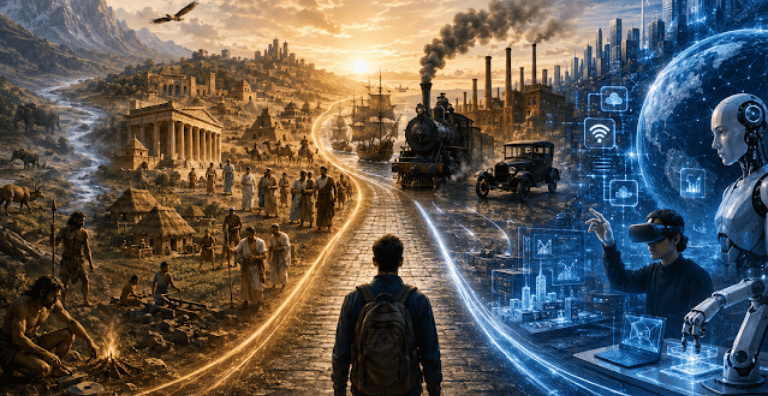
The universe thrives on the concept of evolution, metamorphosis and transformation. Nature never remains static mountains rise and erode, rivers change their courses, species adapt, evolve, migrate, or disappear and climate and ecosystems continually change. New forms of life emerge while others become extinct. Evolution therefore isn’t a straight line toward better. It is largely about adaptation to changing circumstances. There have been major dominant transformations over the centuries. Be it in the prehistoric era- biological evolution, survival and migration amongst species. In the agricultural era humans settled, farmed and created villages and civilizations. In the ancient civilizations writing, trade, governments, mathematics and philosophy gained prominence to run the entire human ecosystem and civilisations. In the medieval period- kingdoms, religions, commerce, scientific knowledge gained relevance forming new social, political and governance structures to run the society. In the time period between 1500–1800s exploration, global trade, scientific revolution created avenues to conduct business and build empires. During the Industrial Revolution machines, factories and mass production gave birth to new business models and new ways of conducting business and trade. In the1900s electricity, automobiles, aviation, medicine, mass communication pivoted the world into a new era of flourishing innovation uplifting the style of living. In the late 1900s–2000s computers, internet, research and innovation, a new digital era and globalization led to world into a different tangent of growth. Concepts like Mcdonaldization, adaptation, building up of global supply chains, FDI, cross border knowledge transfer came into picture. In the 21st century era topics of brouhaha are AI, biotechnology, automation, digital economies, digital sovereignty, metaverse, humanoids, space colonization and much more. These are challenging the old world by creating new avenues for a fully digital future. The remarkable thing is that the pace of change itself has evolved. For thousands of years, major changes took centuries. Then industrialization compressed transformation into decades. Digital technology compressed it further into years or even months. There is a recurring pattern: Change leads to adaptation that creates competition that promotes innovation eventually creating a new equilibrium and scope for further change. This applies to a species, a business, a country, a technology, or an individual. A person or institution that assumes the world will remain as it is eventually becomes vulnerable and perishes. The ability to learn, adapt and reinvent is increasingly important especially in this AI dominated world. And there is an interesting paradox- the more rapidly the external world changes, the more important certain internal qualities become—judgment, resilience, curiosity, relationships, values and the ability to think independently. Technology may change dramatically from century to century, but human needs such as belonging, purpose, security, love, status, meaning and aspiration remain remarkably persistent. So perhaps the most important lesson of evolution is not simply change is inevitable, it is the world keeps changing therefore, the capacity to change intelligently is one of the greatest forms of strength. Let’s explore how businesses have transformed over centuries/ decades. Besides holistic change across the world, businesses also change due to paradigm shifts but they rarely change simply because they want to. They change because of necessity, opportunity, crisis, competition, technology, regulation, scarcity, globalization, geopolitics and changing human behaviour that makes the old way insufficient. You can think of business evolution as: Pressure → adaptation → experimentation → new business model → new industry structure. We have seen this play out over decades. The 1900s–1920s was an era of mechanisation and mass production. The industrial economy moved from labour-intensive production toward machines, standardisation and scale. The automobile industry is a classic example. Mass production dramatically changed the economics of manufacturing resulting in factories, assembly lines, standardised products and large corporations. The important lesson was technology doesn’t merely improve an existing business, it can change the optimal size and structure of the business. The 1930s–1940s was a time when crisis forced radical adaptation. The Great Depression and World War II created enormous economic pressure hence companies had to deal with shortages, rationing disrupted supply chains, government intervention, changes in consumer demand and massive manufacturing requirements. Hence businesses learned cost discipline, operational efficiency, diversification and resource substitution. War also accelerated technologies such as aviation, radar, telecommunications and computing. A crisis therefore often produces something interesting short-term destruction and long-term technological acceleration. The 1950s–1960s was about scale, branding and consumer capitalism. After WWII, rising incomes and mass consumption created huge opportunities. Businesses increasingly competed through brand, distribution, advertising and scale. Companies didn’t just manufacture products they built consumer identities around them. Television became an extraordinarily powerful business technology because it changed how companies reached consumers. The competitive advantage increasingly became who can build the strongest brand and distribution network. The 1970s was the time of energy crisis and efficiency. The oil shocks changed the economics of entire industries. Suddenly energy was expensive, large inefficient vehicles became less attractive, manufacturing costs increased, inflation became a major concern. This stimulated investment in fuel efficiency, smaller cars, automation and alternative energy research. This is a great example of necessity creating innovation. In the 1980s computers transformed the corporation. Computers moved from specialised systems into mainstream business. Businesses began using them for accounting, inventory, manufacturing, databases, financial analysis, communication, office productivity. The transformation wasn’t simply technological. It changed how information moved inside an organisation. Previously the process was information → paper → people → decisions. Due to adoption of technology the process went as follows data → computer → analysis → decision. That laid the foundation for today’s data-driven businesses. The 1990s was the time of the internet and globalisation. This was one of the biggest structural changes in modern business. The internet dramatically reduced the cost of information, communication and distribution. At the same time, globalisation enabled companies to separate R&D, manufacturing, supply chains, sales and customer service across different countries. This produced the modern global corporation. And then the internet created completely new businesses rather than merely improving old ones. Amazon, Google, eBay and many others were fundamentally internet-native businesses. The 2000s was the time of mobile,
The Geopolitics of Compute: AI and the Reindustrialization of Nations
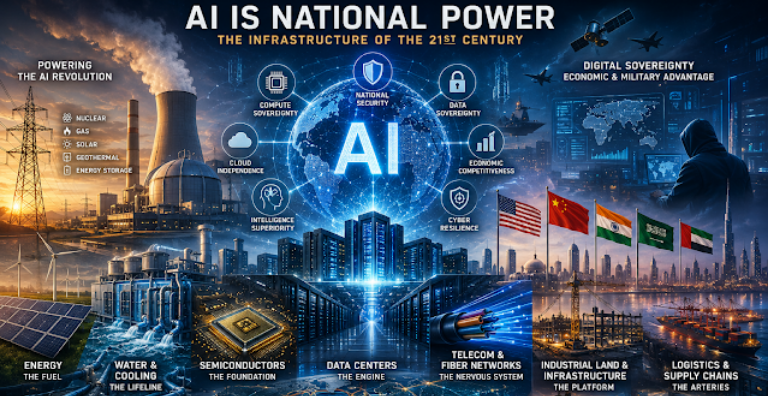
The AI revolution is becoming synonymous to electricity in the 20th century, oil during industrialization and nuclear capability during the Cold War. Countries are no longer seeing AI as ‘just tech’. They are seeing it as an economic infrastructure, military leverage, geopolitical power and critical to national security. Nations globally want to build their own indigenous AI stack and systems to maintain self-sufficiency especially in the current times as deglobalization and supply chain vulnerabilities are becoming visible. Governments fear dependence on foreign AI for critical systems such as military software dependent on foreign cloud providers, national data processed externally and emergency infrastructure controlled by foreign AI systems. That creates strategic vulnerability. A country dependent on foreign AI systems risks surveillance, hidden backdoors, sanctions, cutoff from compute access, manipulation of information and economic dependence. Therefore nations like the United States, China, India, Saudi Arabia, and United Arab Emirates are investing heavily in sovereign AI stacks. Countries want to build their own sovereign clouds, local models, domestic compute, trusted semiconductor supply and national cybersecurity capability. The broader consensus is that future national power may depend not only on GDP or military size but on who controls the intelligence infrastructure underlying economics and society. The objective of AI as national security is resurrecting the old forgotten and neglected hardware infrastructure industries that were once considered old economy sectors such as power generation, utilities, industrial cooling, construction, chip fabrication, logistics, water systems and telecom infrastructure. The AI revolution may become the largest infrastructure buildout since the industrial age. Every AI query devours enormous amounts of energy, AI models need massive data centers to run on, data centers require cooling systems, cooling systems require abundant water and energy sources, chips require advanced manufacturing and everything else depends on stable grid power. This blog will highlight the alarming importance of AI as a national security issue, the industries that are gaining back prominence thanks to this shift and which industries can nations focus on to build their own sovereign AI stacks and the infrastructure around it. Let’s look at the example of China and how they have built a country that is ready to ride the AI wave in a self-sufficient manner. China treated the internet as strategic infrastructure in its early days, it was a well thought out strategy and architecture. While many countries viewed the internet mainly as commerce, entertainment, or consumer technology. China viewed it as an economic infrastructure, information infrastructure and national security infrastructure. This led to a change in policy direction and the goal became to never allow core digital systems to be entirely dependent on foreign control. Examples include Huawei in telecom infrastructure, Alibaba in cloud and e-commerce, Tencent in digital ecosystems, Baidu in search and AI, ByteDance in algorithms and recommendation systems. This created domestic cloud infrastructure, local data storage, indigenous software ecosystems, internal digital supply chains ,national cybersecurity rules and internal digital governance. Globally, the ‘Great Firewall’ was often discussed mainly as censorship. However the ‘Great Firewall’ was all about sovereignty. Strategically, it functioned as a digital sovereignty layer, domestic ecosystem protection, cyber control architecture and internal data localization mechanism. It created space for local firms to scale massively without being overwhelmed by foreign platforms early on. That helped domestic champions accumulate users, data, capital, engineering talent and AI training resources. Strategically, this meant that sensitive national data stayed inside national jurisdiction, domestic firms controlled major data flows and AI systems had access to enormous local datasets. Data became viewed similarly to strategic resources, industrial assets, economic infrastructure. China did not rely only on private venture capital it combined state funding, subsidies, long-term industrial planning, infrastructure financing and protected scaling environments. This allowed investments in semiconductor fabs, AI parks, cloud infrastructure, telecom equipment and smart manufacturing. China has increasingly integrated AI into manufacturing, logistics, surveillance, finance, military systems and industrial planning. The state viewed AI as productivity infrastructure, strategic capability, military multiplier and economic competitiveness tool. This led to national AI strategies, state-supported AI labs and compute infrastructure expansion. China’s rise showed the world that internet infrastructure is national power, AI capability is industrial capability, compute is geopolitical leverage and digital sovereignty increasingly matters. It’s a lesson for nations to treat AI, telecom, cloud, semiconductors, and infrastructure as strategic national assets rather than only private commercial sectors. Many regions are now pursuing their own versions of ‘digital sovereignty’: The common realization is a nation dependent entirely on foreign digital infrastructure may eventually face strategic vulnerability. This is proving true in the current geopolitical dynamics. Besides national security dependence on outsourced digital infrastructure can seriously affect internal security ecosystem like intelligence dominance, data sovereignty, social stability, information integrity with narrative peddling by vested foreign interests. What can other nations do to become AI savvy and become digitally sovereign nations? AI has turned compute into a strategic resource. Previously countries imported software and this dependence was inconvenient but manageable. Now AI systems influence defence, intelligence gathering, finance, cyber operations, biotech, industrial productivity, information ecosystems. Hence making compute sovereignty is strategically important for the future. That’s why leaders are discussing sovereign clouds, national GPU reserves, domestic semiconductor capability, local AI models and protected data infrastructure. AI is becoming the defining infrastructure layer of the 21st century. AI capability now fosters GDP growth, military competitiveness, labour productivity, scientific leadership and financial power. Hence governments are subsidizing AI compute, funding semiconductor plants, building sovereign clouds, partnering with energy firms and creating national AI missions. For example European Union AI sovereignty initiatives, OpenAI partnerships with governments, Microsoft and Google building massive global AI infrastructure, sovereign AI programs in the Gulf and Asia. The AI era is re-industrializing technology. The winners may not only be app companies or consumer internet platforms but increasingly valuable sectors will include electricity, utilities, semiconductors, industrial automation, telecom infrastructure, cooling systems, energy storage, nuclear engineering, construction engineering and optical networking. Therefore investors and governments now see AI as a convergence of software + industrial systems + energy infrastructure. If AI is the cognitive engine of national security, the physical elements such as power, semiconductors, water,
The elements of power in the 21st Century Mining Not Drilling will rewrite geopolitics and world order
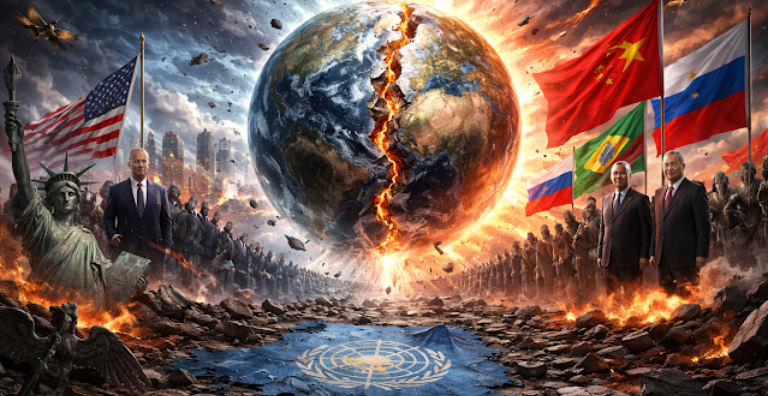
The power dynamics in the world of geopolitics is never cast in stone, it keeps changing based on which region has favorable cards in their hands. As Ray Dalio mentions no empire can last forever, they are bound by cycles. A dominant power in one era can become a weak nation in next era as seen with the rise and fall of empires from the Dutch to the British to the American and probably the rise of the Chinese over the coming decades. In the 20th century nations that could claim geopolitical power were the ones who had control over gold reserves, military strength, industrial manufacturing, oil control and reserve currency dominance. It was a century defined by energy extraction, military force and financial dominance. Tectonic shift in power dynamics led by critical minerals, AI, Currency- the new axis of global power In the 21st century power is shifting to nations that have access to critical minerals, rare earth elements, their supply chain control, semiconductor dominance, energy transition leadership, technological ecosystems and cyber and AI capabilities. The 21st century is all about technology systems, energy transition, mineral control and digital infrastructure. There has been a metamorphic shift in the geopolitical world as world view has shifted from oil fields and tankers to battery plants and chip fabs and from gold vaults to data centers. Oil geopolitics was about energy security; mineral geopolitics will be about technological supremacy. The next hegemon will control materials that power AI, defense systems, space tech and electrified infrastructure. Critical minerals have become a strategic asset and having ownership of them is of utmost importance for national and economic security and energy infrastructure for any nation. Like access to oil was dominated by certain regions (eg: OPEC or OPEC+) access to critical minerals too is geographically concentrated by a handful of regions eg: China, Africa, Latin America and Australia. These new nations will come to center stage in the coming decades as other nations (developed and developing) try to build strategic alliances with these nations to secure access to the critical minerals and their supply chain. In addition nations may try to identify ways to become self-sufficient by building their own critical mineral supply chains (refining, processing etc) or explore their regions for extraction these of critical materials. Let’s see how critical minerals are rewriting world power dominance, geopolitics, business dynamics, defense, currency power and AI supremacy? Critical minerals are the new oil and new crown jewel- lithium, cobalt, nickel, copper, graphite, rare earth elements. Let’s zoom back in time and see what factors characterized strong dominant nations: Before oil became a dominant strategic source national power was displayed by factors such as land and agriculture, precious metals (gold and silver), access and control of trade routes/ naval power, coal as a dominant resource powering industrialization, military power and strength and population size (manpower/ labour). Oil rich nations essentially the OPEC nations rose to power in the 20th century as demand for oil accelerated astronomically. Oil was a major source of power as it fueled automobiles, manufacturing processes in factories, aviation, defense and in turn economic growth. The US created the petrodollars system as a tool to maintain its currency dominance after letting go of the gold standards, to reinforce US financial power, US geopolitical leverage and dollar dominance and hegemony. Countries with large oil reserves or control over oil trade gained enormous leverage. However as the world gravitates towards electrification and AI adoption; a new recipe for geopolitical leverage has come to light: Critical Minerals and Rare Earth Elements. These materials are powering today’s EVs, batteries, AI data centers, renewable energy, semiconductors. Countries that lead in EV manufacturing, AI chips, advanced batteries and nuclear power will shape the next era of power. AI dominance will depend on semiconductors, advanced chips, rare earth magnets, power and data centers. AI supremacy will not be about algorithms but about who will control the materials that build the machines that train the algorithms. So, who has been the early winner in the race of the hare and tortoise? China had strategic foresight to predict the importance of critical minerals and rare earths. They made strategic, calculated and deliberate policies over the last decades to build a dominant position for itself in the minerals supply chain, a vision extended by Deng Xiaoping in the 90s. China is home to a vast reservoir of critical minerals and rare earth and on top of that it has built a complete manufacturing ecosystem around it including mining, extraction, refining, processing and manufacturing. It dominates in rare earth processing, battery supply chains and solar panel manufacturing. In addition China has had the first mover advantage of securing critical minerals via its belt and road initiative around the world in countries like Latin America and Africa. Today China holds the power to influence trade negotiations and impose export restrictions as a single source supplier for majority of these materials. China boasts a leverage similar to what OPEC nations had from the 1970s, it is a single dominate player. Let’s have a look at the nations that have a dominating position in critical minerals and rare earths. China controls around 60% of global rare earth mining and 90% of processing and refining especially for magnets. The democratic republic of Congo produces around 70% of worlds cobalt. Australia and Chile are mining producers of lithium, 50% and 25% respectively while China controls refining and processing of 60% of lithium. Indonesia has 42% of global reserves of nickel. China dominates 3/4th of global graphite output followed by smaller players like Brazil, Mozambique and Madagascar. Chile is the leading exporter of copper, followed by China, Peru and DRC. The Lithium triangle, Chile, Bolivia and Argentina is renowned for 75% of global reserves found. According to IEA, China controls processing and refining of 19 out of 20 strategic minerals. These countries will gain geopolitical leverage in the 21st century. Middle East oil economies are diversifying to remain relevant in
A new world order created by humans for humans- homo sapiens to robo sapiens.

The human race has come a long way from establishing itself as the predominant homo sapiens species alive on the planet, to creating powerful, innovative and pathbreaking technologies. Essentially AI that is yet to play a major role in how our species will evolve or may we say struggle and fight to evolve alongside it’s own hand created competitor humanoids? Humans are probably creating a new race called robo sapiens! However only time will tell how true this premise will be. How did the world structures designed by homo sapiens look like until now? Humans have dominated plant earth by evolving over long periods of time with changes in biology, genetic makeup, behaviors, psychology ultimately winning the tag of survival of the fittest amongst the other weaker species. Human race has craved freedom, independence, attention, acknowledgement, validation, accomplishment and sense of achievement. However, above all is their desire for power and control. One way to achieve that, was the creation of social structures, systems, and subsystems in the form of religion, social and cultural structure (being part of a community), family structures, governance structures and politics to create order in chaos. Humans have always had this deep-seated desire to control everything be it people, their behaviors, habits, reactions. Human psychology can be immensely complex and therefore it is uncertain to understand what another person thinks, maybe this innate desire and quest to understand humans and control their reactions, humans ended up creating human machines that can be controlled by them and dance to their command to satisfy their need for control and dominance. Nonetheless this inclination to experiment with creating a human machine (humanoids) that can be controlled can backfire where it gains so much power to reverse the power dynamics that has existed for millenniums. Humanoids where data will be the new life force can become a part of our everyday life not just employed in warehouses and factories. They will work on a combination of machine learning and artificial intelligence suited to meet the personalized needs and requirements of their human owner. Finally, humans can have full control on their personal humanoid and tweak it to meet its needs. Let’s have a look at how AI humanoids will have a metamorphic impact on how the world will function over the coming decades. AI humanoids will transform social structures, reshaping roles, relationships and cultural norms. Humanoids can act as companions, caregivers and therapists to help beat loneliness for the elderly and those who suffer from social anxiety. However, over time humans can grow emotionally attached and dependent to these machines as they will always meet their expectations that another human may sometimes falter to meet, dehumanizing existing human relationships. This may lead to humans living in a delusional reality avoiding interaction with other human beings impacting social relations or social structures created by humans. This delusional reality is in fact taking shape as people have started to get addicted to using AI chatbots and are treating them as their best friends, brother, sister and more!! AI humanoid partners challenge marriage and dating norms offering conflict free relationships. AI humanoids could transform marriage, succession (AI as estate planners and caregivers) , kids (AI driven childcare), and birth (low birth rates- falling populations) and risk eroding of emotional bonds and cultural traditions (how the society has functioned since centuries). Imagine a time when humans get so attached to AI that they may leave their wills in the name of their beloved humanoids with regards to succession planning. AI humanoids can have massive implications on human mental state as they will be living in a delusion. In addition humans may be a bit skeptical of using humanoids when it comes privacy of data as AI will collect massive data on their day to day life. They can act as hobby buddies or perfect pals teaching leisure skills like cooking, gaming, painting, dancing and more, reducing human hangouts. In addition overreliance on humanoids will impact organic community engagements like community gatherings or participation in cultural rituals or events leading to cultural erosion. Humanoids will challenge collectivist (Asia) society norms v/s individualist (West) gaining backlash and criticism. Humanoids will be majorly programed with the human and cultural biases created over centuries. They may give more western standardized answers and outlook to questions. Imagine a time when maybe AI will become so powerful that it itself can question the premises of human made biases of culture, religion ( threat to divine order), social structures philosophies and more. The existing generation of this race may resist these answers to these questions, but the new generations may accept these new values and maybe treat AI as the new God. AI humanoids will transform the work environment by automating tasks, reshaping team dynamics and propel new skills. Let’s see how it will impact the workplace and livelihood in the coming decades? AI humanoids can achieve physical and cognitive tasks and can act as co-workers be it in a factory setting or your workplace resulting in flexible production lines, human-robot collaborations and global competitiveness. They will impact job roles in manufacturing, retail, hospitality, health care and caregiving leading to a massive impact on the livelihood of millions. While they may automate numerous tasks they will create a way for new job titles such as robot maintenance, ethics oversight, AI programming. Humanoids can propel a culture of social isolation since they will handle customer facing and team support roles resulting in reduced workplace banter and team cohesion leading to a diminished human touch. While humanoids will be viewed as productivity boosters and efficiency enhancers in settings like the tech forward Silicion Valley (individualist culture) on the flip side they may be viewed as threatening human centric values like empathy, team work and creativity in collectivist cultures. In agriculture sector they will support in precision farming and can address labour shortage issue. Humanoids can work in adverse weather and long hours without fatigue and will also predict crop yield, detect
Old charm of physical assets is back on the rise: Tokenization is the way!

Imagine a time when you can own a fractional part of vineyards in Boudreaux, Burgundy or Provence in France or owning a part of a coffee farm or estate in Brazil, having fractional ownership in a diamond and gold mines in Russia and Africa, owning magical flower gardens/parks in the picturesque European cities, imagine owning a fraction of Amazon’s data center or Microsoft’s data center, owning a part of fascinating bridges over the USA or China or owning a fraction of a luxury apartment in the Beverly hills or an exotic villa or hotel in Hawaii. These ideas are relishing for any investor and there is a possibility that these may come into reality thanks to tokenization of physical assets. The old charm of physical assets may be gaining traction once again due to multiple reasons. Let’s discuss them below! In today’s age and time economic uncertainty is reaching alarming levels as countries try to conquer their own debt crisis and the global debt crisis. The global sovereign debt is hitting $324 trillion in 2025. The US federal debt is touching a staggering $36.2 trillion, and we are not new to this struggle the US is encountering to nurse. Currently the US is dealing with a fiscal deficit of $1.4 trillion and is paying $300 billion in interest per day surpassing its defense spending. The US has had the supreme power and upper hand in printing money (quantitative easing) to nurse its piling debt in the hope of fostering economic activity to overcome the debt built up over decades. However things have gone south as the excess liquidity post COVID- 19 has not ended up being invested in productive assets causing inflation, in turn aggravating asset bubbles in the equity market. Unchecked money supply, major allocation of resources to unproductive assets, uncertain global geopolitical environment and wars is causing unrestrained inflationary pressure, crippling the lower- and middle-class consumers the hardest globally. Considering an uncertain future and tumultuous economic and geopolitical environment investors can direct their resources and diversify their portfolio to include physical hard assets (real estate via REITS or tokenization, precious metals, agricultural land, agri plantations, mines, infrastructure assets (like airports, ports, data centers) via INvits, collectibles via tokenization) to get better inflation adjusted returns than merely relying on bonds, stock and cash. Hence considering the present environment, the shrinking middle class incomes and asset bubble, investors must do some out of box thinking to manage their personal finance especially the middle class need to pivot investing instead of traditional ways of saving whatever is left out of their income. Investing through tokenization in physical assets or equity investing is a panacea for middle class retail investor in these tough times especially because of limited resources/ capital availability in their hand and more so they are constrained by inflation, limited wage/income growth, lopsided savings and their jobs are facing serious threat from AI. Tokenization will become a starting point of investing journey for the new and future generations who possess limited resources but can reap the benefits of compounding by investing in fractional parts of assets. Tokenization presents a new wave of investing opportunity in large growth orientated asset classes for the middle-class retail investor, making illiquid assets liquid. Tokenization presents an opportunity for new retails investors to invest across a variety of asset classes by owning factional amounts of that asset eg: real estate, arts and collectibles, sports teams, commodities, luxury goods and much more listed in the table below: For example, retail investors can get the fractional ownership of a property by purchasing tokens lowering the barrier to entry for smaller investors who cannot afford to purchase the entire property. They can also get profit sharing for capital appreciation for the property and rental income from it too. It is usually challenging to sell a property due to its illiquid nature, however by owning tokens individuals can sell the tokens on the secondary market to generate liquidity at any time. Tokenization of commodities is making it easier for small inventors to invest in physical assets like gold, oil and much more. Gold is considered a safe haven during volatility or crisis like situations. However, owning physical gold can come with its challenges such as buying, storing and selling. Hence tokenization of gold or even purchasing ETFs provide a convenient solution to investors who seek to invest in gold. The same can be applicable to other physical commodities. Investing in private equity (also venture capital, hedge funds and ETFs) will become easier as tokenization provides an entry point for small investors, since it’s been an asset class that has been mainly dominated by large institutions or HNIs. Institutional investors will also get the opportunity of liquidity due to tokenization investment by retail investors in illiquid private equity investments. Investors can get access to ownership of art and collectibles via NFTs. Artists can sell their digital art directly to the collector eradicating the need of traditional intermediaries like galleries and auction houses. Investors can own parts of intellectual property like copyrights or patents of music, books, art and much more. Investors can invest in assets across the globe providing them with a diversified portfolio to accrue benefits. There will be a possibility of improved market efficiency due to the adoption of blockchain eradicating middlemen, reducing costs, errors and enabling quicker transactions. The utilization of blockchain in tokenization will improve security and transparency ensuring correct payouts. However the tokenization brings its own set of challenges due to underlying and backend blockchain technology since it is still a novel and evolving technology and has issues to gain scalable traction until it evolves to high volume transactions at sustainable speed. There is quite a lot of uncertainty with regards to regulations across different countries on tokenization of assets. New investors may take time to adopt to the technology due to mistrust for this new technology due to certain security risks (cybersecurity related risks) thus limiting liquidity on the secondary market. It will take time
A new dimension of survival of the fittest doctrine in the world of investing

The world of investments has enamoured countless individuals and produced the most competent and intelligent investors worldwide. Though this profession is sought after for its incredible returns, perks, glitz and glamour as portrayed in popular media, in reality individuals fail to reckon the countless hours of study, analysis, deliberation, debates and discussions involved in final investments decisions. Pure fundamental investments are where real wealth is created and this has been time and again proved by the performance and wisdom of successful investors like Warren Buffet, Benjamin Graham, Charlie Munger, Philip Fisher, Peter Lynch and many more. A little word on the contributions of these master investors. Benjamin Graham has been a mentor to Warren Buffet. He has made immense contribution to the world of investment with his books, most notably the ‘Intelligent Investor’ that is considered as a bible to investing. He is a proponent of value investing and quantitative fundamental analysis. He stresses on the concept of margin of safety when buying stocks. This essentially means buying a stock at a discount from its intrinsic value hence reducing the chances of major losses in case the stock doesn’t perform well. Furthermore Graham advocated diversification of a portfolio within and across asset classes. He proposed to take advantage of market volatility to get best value eg: buy during market downturn and sell at good times. Warren Buffet the oracle of Omaha has been a highly reputable figure in the world of investing and is a disciple of Benjamin Graham. Buffet is known for his nuggets of wisdom like adopting an owners mindset whilst investing in a company and the concept of investing in a business that has a strong moat or competitive advantage. His idea of adhering to your circle of competence i.e. invest in businesses that are easy and comfortable to grasp and understand, is a critical step to contemplate whilst studying companies. He is a proponent of the phenomenon of compounding that is the ultimate recipe of creating long term wealth if invested in a good quality business. Buffet’s business partner and friend Charlie Munger has played a pivotal role in refining Buffet’s investment practices by introducing him to take a look at businesses from a qualitative lens (i.e. quality of management, quality of business) than just scrutinising a businesses based on its quantitative aspects. Munger promoted the idea of buying wonderful businesses at a fair price and giving up buying fair businesses at wonderful price. He emphasised the idea of independent thinking and decision making (carrying out your own study) and avoiding herd mentality. He has been an advocate of life long learning and having the ability to constantly learn and acknowledge personal biases whilst making investing decisions. Philip Fisher has created a mark in the investing world by introducing the term ‘scuttlebutt’ i.e. collect data about a business from all its stakeholders ( competitors, customers, suppliers, employees, research analysts or industry experts) to analyse and scrutinise a business, an innovative form of due diligence apart from the usual quantitative due diligence. He also advocated a buy and hold strategy for good quality businesses. In his book Common Stocks and Uncommon Profits he shares his 15 stage strategy to identify star businesses. He lays emphasis on the qualitative factors of a business for instance studying its industry, its competitors, its right to win, management team, it products or services, it ability to invest in R&D (to constantly innovate), its organisational structure and much more. Peter Lynch is another celebrated name in the investment world and has made his contributions. He was also a proponent of the PEG ratio to value businesses. He promoted the idea of writing down a thesis for your investment so you don’t get clouded by your own psychology biases and judgements of others or event that occurs in the external environment. He stresses on investing in high growth niche companies. In the world of business, innumerable businesses are at war with one another. At the end the businesses that survive the test of time are the ones that innovate, are flexible and adapt to the changing competitive landscape, consumer behaviour, technological innovations, the economic and geopolitical scenario. These businesses that survive for decades or centuries are clear examples of the survival of the fittest in Darwin’s theory of evolution. The theory of survival of the fittest plays a humongous role in many different fields and investments is one of them as well. The investor has to be adept to respond to the changes in the external environment and refine his investment portfolio accordingly to survive the uncertain business environment. One Indian investor has gained fame for his intellectual contribution to the world of Indian equities. Pulak Prasad has studied and taken a holistic view of how investments work and married the concepts with Darwin’s theory of evolution. He has created a customised concoction of investment strategies to invest in the Indian markets using the investment theories of legendary investors mentioned above and the theory of Darwin. ‘What I learnt about investing from Darwin’ is an exceptional repository of teachings to invest in the stock market for the long term fundamental business investor. Pulak Prasad enlists and discusses about how he and his team at Nalanda have conceptualised a chronological framework via which they filter out companies and take a deep dive into evaluating companies that are worth to invest in. This enticing book can be synonymous to being called the bible to invest in the Indian Stock Market. It is an absolute delight to read the book and every reader will not only learn about investing but also learn interesting facts about biology and the parallels drawn between the two fields. Prasad enlists a series of quantitative and qualitative factors that can be applied to drill down on the most deserving companies. Let’s have a look at some of these interesting concepts. Prasad firmly states that he and his team judge a companies quality by studying its past performance eg: 10 year
The moment of epiphany: EV’s are not the super hero yet!

The EV fever seems to be diminishing as reality and rationality come to picture. EV’s were promoted and popularised on the premises that they are an eco-friendly alternative whilst hybrids act as a transitionary vehicle/ technology in the race to reach the goal of zero emissions. Few years back Toyota had shared their skepticism about an all EV fleet and instead proposed the importance of hybrid cars that are much more efficient and realistic that a regular EV. They implied that EV’s are not entirely environmental friendly as they are ultimately being powered by electricity that is generated from coal power plants. Toyota’s perspective met with bountiful criticism and cynicism as they seemed to lose their innovative streak. However it seems the tables have turned and Toyota was indeed right in its approach of having a variety of models such as hybrids ( or hydrogen powered vehicles, flex fuels, CNG etc) than only relying on EVs. Due to their novelty factor, EV sales witnessed a meteoric rise as car companies and governments around the world vowed to eradicate ICE powered cars and replace them with EV’s to reach net zero emission targets. Supported by governmental initiatives and subsidies (in USA, Europe, China, India) , the who’s who of the the car industry invested billions on R&D efforts, ramped up plant capacities and built new supply chains to accommodate EV’s. In China the subsides for auto companies and customers include various variations such as tax breaks, low interest loans, capped energy costs and funds for plant construction. In Norway the benefits include city toll exemptions, free parking, access to free charging stations and much more. However in the journey auto companies have had to encounter intense pressures on their margins and profitability and in addition customers have voiced out their worries and concerns about EV’s. This thus questions the commercial viability of producing EVs. As reality seeps in, consumer demands have changed. EV sales seem to encounter a plunge in demand as certain challenges are highlighted such as lack of infrastructure (EV charging stations) to support EV’s, range anxiety amongst customers, the scarcity of renewable energy (connected to the power grids globally) that should ultimately power EV’s to have a positive impact on the environment, price war between EV players induced by cheaper Chinese EV models, higher repair costs of EV’s (essentially the batteries), lower resale value of the vehicles and high insurance cost to top it up. Consumers consider gasoline and hybrid cars to be more affordable than an EV in the US despite the $7500 federal subsidy. There is scarcity of charging infrastructure in the US and around the world with regards to charging an EV at home or at public stations. According to a report by McKinsey and Co, 46% of EV owner in America want to switch to ICE cars. So what are customers look for and what are their demands? A study from the Boston Consulting Group sheds light on the characteristics that buyers expect from their future EV purchase: – Under 20 min charging time – A 350 mile plus driving range – A Price tag under $50,000 In response to the hybrid vehicles demand numerous companies have had to alter their future strategies by incorporating hybrid vehicles in their fleet/ product portfolio rather than solely relying on EVs. Ford has planned to expand its hybrid models in the Northern American market and is pulling breaks on further expansion on EV’s at the moment. Mercedes Benz proclaimed that EV’s along with hybrids will not be able to reach their goal of attaining 50% of sales by 2025 due to a plunge in demand for EVs. Hence, they have delayed this goal to 2030. General Motors has also halted its plan to manufacture 400,000 EV’s by 2024. By 2025, the production of hybrid cars will possibly rise to 20% of the total light vehicle production v/s 14 % for EV’s in the US according to AutoForecast Solution. Whilst brands that had a flexible approach to have wider product portfolio seem to have an upper hand in the game now. Toyota and Honda witnessed a significant rise in the sales of their hybrid vehicles by 16% and 32% respectively last year in the USA. By incorporating hybrids in their portfolios companies can reduce their losses caused by immense investments in EV’s and focus on profitability as hybrids and ICE cars have similar margins. Ford shared data regarding its EV business that states that they bear a loss of $4.7 billion last year (around $40,000 per vehicle). There has been major improvements in the amount of pollutants (SOx, carbon monoxide and NOx and many more) that can be emitted form ICE vehicles thanks to stringent emission standards such as Euro emission standards 6 ( in Europe) or BS 6 (in India). Euro emission standard 7 is expected to be applied from July 2025 that demands cars to restrict the emission of nitrogen oxide to no more than 60 mg. This suggests that ICE vehicles are going to become more eco friendly over time and still may continue to dominate market share along with hybrids and EVs. In addition the ICE element in hybrids will also become cleaner making hybrids much more preferred cars. In march 2024, the US department of transportation has favoured hybrid and gasoline vehicles in its new rules for fuel economy and vehicle emission till early next decade; hence delaying EV roll outs. Considering the India EV story auto companies are only able to survive in the race to ace EV’s due to the support of the FAME I and II subsidies by the government. There has been debate about the sustainability of EV’s as a whole once the subsidies are abolished. For instance in Germany (the largest automative market in Europe) the government has decided to bring EV subsides to zero thus impacting 60,000 EV sales. The Netherlands has curbed subsidies for plug in hybrids and EV’s. Car companies have demanded subsides or
Are the world power grids sustainable enough to handle the Herculean energy needs of technologies of the future?

A power grid is a complex network that constitutes the generation, transmission and distribution of power to consumers. It is a life line for seamless functioning of the society. However, today the global power girds sustainability and longitivtiy is endangered by the impending demand generated by new age technologies. It is predicted by IEA that by 2040 the would will need to add or revamp 80 million km of grids (equivalent to the capacity present today) to to achieve electricity security and achieve its environment climate targets. The developed world is encountering the challenge of old power infrastructure to meet the need for electrification of transportation (widespread shift to EVs), factories etc, incorporation of renewable sources of energy to the power grid, augmenting power of power hungry artificial intelligence, blockchain, hydrogen production and more. Around 70% of transmission line in the United States are older than 25 years. In Europe 40% of the power grid is 40 years old or more. There is dearth of and long lead times for basic gird equipments and raw materials (like copper- rising prices) or energy infrastructure eg: transmission wires, transformers, electrical wires, cables and more for creating, modifying or renovating the power grids. According to an article in FT the demand for high voltage cables has been on rapid rise, between 2015-20 only $3 billion projects were awarded per year however that figure had skyrocketed to $11 billion in 2022. According to Massimo Battaini (CEO of Prysmian- into the business of production of electrical cables- European firm) the value of new orders will be more than $20 billion dollars, he also mentions that the company is booked till FY 26/27 suggesting investments being made in the space. While the European Union’s power/national grid is very much integrated between borders there are multiple projects that are on hold due to shortage in basic grid equipments as discussed above. So what is driving the incessant need for power? AI and Blockchain- Data Centres Innovation and advancements in AI play a major factor leading to enormous need for power as the computing infrastructure needed to support AI is very different from the traditional data centres. Furthermore crypto- mining and blockchain are creating demand for data centres as well. According to IEA there are around 2700 data centres in the US that enervate 4% of total electricity (2022) and is believed to increase to 6% by 2026. It is believed that information and communication technologies will consume around 8000 TwH (electricity and power) by 2030. It is predicted that AI may consumes ten times more power by 2026. A search on ChatGPT commands 10 times electricity v/s one google search. Training a model like chatGPT and the machine learning behind it is astronomically energy intensive. Considering ChatGPT caters to 200 million requests per day, it is devouring more than half million kWh of electricity. Alex de Vries suggests if google incorporates AI in every search, its energy consumption would rise 29 billion kWh every year (more than energy consumed in Croatia, Guatemala and Kenya). Nvidia’s (the famous chip maker that is bolstering the AI wave) H100 GPUs consumes as much as 700 W of power equal to or more than the consumption of an average American household. At the moment we are exploring AI at its nascent stages which still requires Herculean amounts of power to support it. Once we reach the level of AGI (artificial general intelligence) i.e. AI’s ability to mimic humans and cognitive skills, this will lead to an astronomical surge in demand for more enhanced and upgraded versions of GPUs and chips and power. Mr Huang had shared his views on AGI implying they this may become a reality in a time frame of 5 years or more. It is believed if Nvidia sells a total of 3.5 million H100 GPUs by 2024 they will devour approx 13,000 GwH of electricity per year. This would equate to the power consumption of countries such a Lithuania, Georgia. Intertwining renewable energy into the power grid— decarbonisation initiatives. Global investments in the power gird has been static however huge investments have been made in renewable energy and its capacity expansion. Thus there is a huge queue of renewable projects waiting to get connected to the gird. In addition the shortage of grid equipment hampers the transition to clean energy. SO WHAT IS THE REASON FOR THIS? As mentioned above the power girds of the developed world are aging and are in dire need for upgradation to work with the new evolving sources of energy. Solar and wind farms are located in remote areas far from the actual grid that makes it difficult to connect the two together. There is a huge need for build up of transmission lines that can connect the solar and wind farms to the grid. However this a very costly and time consuming process and involves a plethora of regulatory related and bureaucracy issues that hinders the timeline of projects. In order to accommodate the intermittency of the supply of solar and wind power, grids have to become flexible to manoeuvre the supply and demand and avoid power outages to reach to the end users at the right place and right time. So one of the solution is storage of the energy however there is more work and research to be done on this area. In addition the adoption of green hydrogen will face obstacles until renewable energy is able to find its way into the power grid to propel the use case of green hydrogen. Electrification of vehicles and other transportation, homes, industries and more. According to an article by CNBC there is an urgency to ramp up the power grid in order to support the surge in electric vehicles on the streets in the coming years. There is an acute need for high voltage transmission lines, transformers and distribution lines. Elon Musk has warned about a possible shortage in transformers by 2025 due the berserk amplifying power of AI and constant innovations in it wanting more energy and
Is our existence guaranteed?… heading towards population implosion!

Malthus predicted that an exponential increase in population will lead to only an arithmetic increase in food production and resulting in shortage of food more of a doom scenario. Boesrup asserted that regardless of population explosion human beings posses the ability and intelligence to innovate and support themselves. Over several decades overpopulation has been christened as a bane for the society for innumerable reasons such as an instigator of rampant poverty worldwide, exuberant consumption practices due to industrial activities propelling climate change and global warming and leading to a rising paucity of natural resources to meet the needs of the growing population. While Boserup’s predictions haven’t been officially agreed upon it still does resonate with what is happening at the present moment. Human ideas and their zeal for innovations and revolution have transformed the way we live, eat, age, travel, and purchase. The most unconventional ideas have been brought into reality. With the introduction of smart cities to vast adoption of electrical vehicles to purchasing goods via e-commerece or even social commerce (on social media platforms), the establishment of meticulous and immaculate global supply chains due to globalisation, possibilities of mass commercialisation of self driving cars, to manifold innovation in medicine and health care and vertical agriculture. Moreover industry behemoths like Elon Musk, Jeff Bezos and Richard Branson have brought to life a revolutionary idea, space tourism so there is a possibility that by the end of this century humans beings can inhabit mars or the moon. This idea of multiplanetray human beings has been doing rounds in the grapevine across a plethora of experts belonging to the world of science and business. Elon Musk and Jeff Bezos and even Jack Ma have been advocates of humans becoming multiplanetray species. Musk insists on having a plan B to live as earth is embroiled with a spectrum of problems like climate change, war and so forth. Today leaders (political or business) are perturbed by the conundrum of population implosion than population explosion. According to the figures published by the UN, the world population hit 8 billion in November in 2022. The IHME highlights that by 2064 the total global population will reach its peak at 9.73 billion and decline by a billion by the end of the century. According to Eurostat the EU population will peak at 453 million in 2025 and decline to 420 million in 2100. Italy will see a major decline from 59 million in 2022 to 50.1 million by 2100. Other countries that may witness a major decline include Greece, Latvia, and Lithuania. In addition by 2100, 30% of EU’s population is expected to be above 65 years old. By 2100 Japan’s population may fall to 72 million from 126 million, South Korea’s population may fall to 24 million from 52 million. Furthermore China too is witnessing a population decline and ageing population, 12% of china’s population is above 65 and its population is expected to fall to 800 million by 2100. The US will have a population of 366 million (without immigration) and 29% of the population will be in the higher age bracket by 2100. These are some striking figures that should be taken seriously! So what has been a reasons for such baffling numbers? Fertility rates have been on the decline and below the replacement rate across the globe in countries such as South Korea, Singapore, Japan and more. Considering the metamorphosis society and social systems have undergone over the last few decades, it is pretty evident why there has been a decline in fertility rates across the world from west to east. Women have earned an equitable right to select between career progression or indulge in family life. In addition due to medical assistance child mortality rates have plunged. The costs of raising children is skyrocketing around the world, even though governments in Europe or Far East have in place pro natalist policies to encourage child brith. While birth rates plunge, there has been a stratospheric rise in aging populations worldwide due to advancements in health care. So what are the consequences of a plummeting population? A decline in population will lead to a dearth of potential labour force that could act as a backbone of economies around the world. In addition it would lead to a significant decline in consumption of goods and services thus hampering the growth of businesses and economic prosperity as a whole. An ageing population with longer life span not only creates pressure on governments that offer social benefits, social security programs and pensions but also on the working population whose taxes make up for these benefits. In addition the government may witness insufficient funding to serve the aging population. Taking into consideration how governments and economies around the world are encountering herculean debt issues, this may lead to further stress on sustainably bolstering the aging population. Today leaders go berserk and are enraged about the ramifications of AI, where it has the potential to surpass human species. In a hypothetical situation as the world population will diminish, more individuals will not only be needed to replace the dead or support the elderly population but also to compete with its own creation AI. Though this may sound like a storyline of a sci-fi movie, there still can be risk of technology dominance if its power outnumbers human beings. Firms like Google via Calico are innovating on the lines of immortality and expanding life expectancy to as much as possible. This may further strain the younger working population. While governments around the world contemplate on raising the retirement age (this may not be a welcomed move), they will need to allocate funds and resources (in partnership with private firms) to train individuals to up-skill, re-skill and upgrade. Even if individuals live longer without any health ailments and continue to play their part in the contributing to the economy, there will still be lack of fresh ideas, new blood or
Permafrost – an ultimatum- fostering the clean energy transition!

The brouhaha surrounding melting glaciers has been in the headlines since a decade or more.In time people’s approach towards preserving the environment has strengthened! Forinstance, as seen from the steady pick up in commercialization of e-vehicles across the world,changing consumer spending habits (purchasing products that are sustainable, the in vogue‘pre-loved fashion’), government initiatives that galvanize a spur in adoption of renewableenergy (the recent proposition of hydrogen as a renewable source) to electrify majority ofcities and the list is endless. However, individuals failed to envisage what implications does the melting pose on thevarious communities that inhabit countries that are built on ice! Think: Alaska, Siberia,Scandinavia, Russia, Artic, Canada and Greenland! This ice is called permafrost and its thawing has sparked alarm about its consequences onhuman life and subsequently the ecosystem. So, what is permafrost? Permafrost has formed over millions of years below the Earth’s surface creating widespreadchunks of land. Permafrost constitutes an amalgamation of rocks, soil and sand; ice beingtheir binding agent. In addition, it is created by water ensnared in the cracks of rocks or insoil and sediment that is frozen over a period of 2 years to hundreds, thousands and millionsof years, creating numerous layers down to the surface of the earth. Permafrost’s presence is ubiquitous across the globe, covering majority of the northernhemisphere such Artic, Siberia, Russia, Canada, Greenland, Alaska, Scandinavia, TibetanPlateau, Arctic Ocean (undersea permafrost) South American Andes and New Zealand. A plethora of indigenous communities have been constructed on permafrost ground. Man-made industrial activities over centuries have been responsible for triggering a glut ofgreenhouse gases emissions in the atmosphere thus resulting in and activating climate changeand global warming across the world. Today communities inhabiting these affected regionsare forced to relocate due the disruption caused to the landscapes by landslides and flooding. Entire infrastructure of towns are under threat for instance melting of permafrost down todeeper levels can rupture sewage pipes and disrupt the functioning of power poles andpowerlines. Furthermore roads, pipelines, fuel storage areas, transportation routes etc arejeopardized as permafrost melts. One can come to a realization that it is not only the islandslike Indonesia and their communities that are sinking due to rising sea levels, but a wholehost of communities residing in the northern hemisphere are too forced to relocate due to theconsequences of climate change. Alarmingly permafrost is believed to store 1500 billion tons of carbon that is double of whatis present in the atmosphere today. According to scientists the emissions caused from thethawing of the permafrost can be equivalent to emissions created by a mid-size country!!Hence permafrost presents itself as a carbon pool. How is this plausible? Well, the plant andanimal remains that failed to undergo the process of decomposition, became embedded in iceovertime. Therefore, as the permafrost melts (fostered by rising temperatures, climate changeand global warming) microbes will now decompose the remains releasing carbon dioxide andmethane aggravating global warming around the world. So, what can we do about this? It is imperative to reduce the emission of fossil fuels from man made activities as this issomething that is in the hands and control of businesses, governments and individual citizens.For now, perhaps there is no solution to restore permafrost or curb its melting but widespreadadoption of cleaner sources of energy for multitude applications (manufacturing, electricity)can delay the melting of permafrost. Permafrost is a refuge for millions of old and new viruses and bacteria, stored over thousandsof years. As the thawing process exacerbates over time, this can jeopardize human life andentire ecosystems as they come into contact with these viruses. These viruses can flow intowater bodies, contaminate land and agricultural produce, infect wildlife and ultimatelyhumans. However, every adversity comes with an opportunity and hence the escape of theseviruses can accelerate prolific research and innovation in the pharma space to identifyremedies for treating potential epidemic and pandemics. The Artic (and Northern Hemisphere under ice) is bejeweled with precious and rare metalsthat are present in copious amounts under the permafrost and Artic Sea. For instance,Greenland is rich in rare earth metals, gold, copper, nickel, cobalt and zinc. All theseresources will bolster our path towards clean energy transition as they are the raw materialsfor batteries for e-vehicles, solar panels, wind turbines and so on. These regions also presentnew possibilities for oil and fossil fuel extraction. The north of the artic circle is supposed tobe a powerhouse of 30% of undiscovered gas and 13% undiscovered oil and containsprecious metals of worth $1 trillion. Not good news for the environmental communities butprobably good news for the business community (in terms of potential business opportunitiesthat can be exploited) The thawing of permafrost will burgeon the expansion of shipping lanes and reduce durationof travel between Europe and Asia for logistical and transportation-based activities. Theseroutes are believed to be the shortest compared to the Suez Canal and Panama Canal hencedecreasing transportation time by 14-20 days, resulting in 24% less emission of greenhousegasses caused by shipping activities. Desolate areas of the artic far from the reach of human life were treated as spots for disposalof radioactive waste from activities such as nuclear testing or nuclear reactors as well asvarious chemicals and biohazards. Thus, suggestive of that fact that these harmful wasteshave been embossed in the permafrost overtime. Furthermore, wastes generated from heavymetal mining in the Artic too would be entrapped in the permafrost. In addition toxicmaterials present in landslides structured upon dry permafrost are now trickling down theirway into rivers and lakes. Hence causing several hazardous consequences as the permafrostthaws and comes into human contact over time. This calls for investigation of immediatesolutions to corroborate how these areas can be managed. As the permafrost melts it will bring with it opportunities for sustaining access to agriculturalproduce for example Siberia can become a potential wheat producer to the world and Canadaa wine producer. In Greenland the sand and sediments collected from the melting of glacierscan be transformed into raw materials for creating concrete, glass or computers. Worldpowers are gearing up for claiming their part of the land in the Artic as it will
