
Business Migration in changing economic landscape to find strategic value
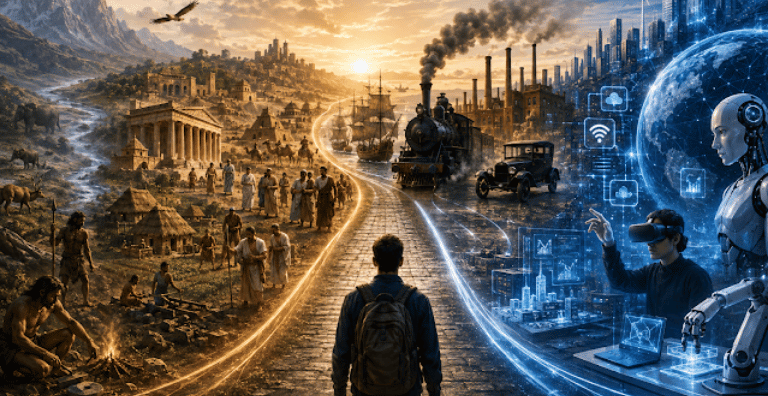
The universe thrives on the concept of evolution, metamorphosis and transformation. Nature never remains static mountains rise and erode, rivers change their courses, species adapt, evolve, migrate, or disappear and climate and ecosystems continually change. New forms of life emerge while others become extinct. Evolution therefore isn’t a straight line toward better. It is largely about adaptation to changing circumstances. There have been major dominant transformations over the centuries. Be it in the prehistoric era- biological evolution, survival and migration amongst species. In the agricultural era humans settled, farmed and created villages and civilizations. In the ancient civilizations writing, trade, governments, mathematics and philosophy gained prominence to run the entire human ecosystem and civilisations. In the medieval period- kingdoms, religions, commerce, scientific knowledge gained relevance forming new social, political and governance structures to run the society. In the time period between 1500–1800s exploration, global trade, scientific revolution created avenues to conduct business and build empires. During the Industrial Revolution machines, factories and mass production gave birth to new business models and new ways of conducting business and trade. In the1900s electricity, automobiles, aviation, medicine, mass communication pivoted the world into a new era of flourishing innovation uplifting the style of living. In the late 1900s–2000s computers, internet, research and innovation, a new digital era and globalization led to world into a different tangent of growth. Concepts like Mcdonaldization, adaptation, building up of global supply chains, FDI, cross border knowledge transfer came into picture. In the 21st century era topics of brouhaha are AI, biotechnology, automation, digital economies, digital sovereignty, metaverse, humanoids, space colonization and much more. These are challenging the old world by creating new avenues for a fully digital future. The remarkable thing is that the pace of change itself has evolved. For thousands of years, major changes took centuries. Then industrialization compressed transformation into decades. Digital technology compressed it further into years or even months. There is a recurring pattern: Change leads to adaptation that creates competition that promotes innovation eventually creating a new equilibrium and scope for further change. This applies to a species, a business, a country, a technology, or an individual. A person or institution that assumes the world will remain as it is eventually becomes vulnerable and perishes. The ability to learn, adapt and reinvent is increasingly important especially in this AI dominated world. And there is an interesting paradox- the more rapidly the external world changes, the more important certain internal qualities become—judgment, resilience, curiosity, relationships, values and the ability to think independently. Technology may change dramatically from century to century, but human needs such as belonging, purpose, security, love, status, meaning and aspiration remain remarkably persistent. So perhaps the most important lesson of evolution is not simply change is inevitable, it is the world keeps changing therefore, the capacity to change intelligently is one of the greatest forms of strength. Let’s explore how businesses have transformed over centuries/ decades. Besides holistic change across the world, businesses also change due to paradigm shifts but they rarely change simply because they want to. They change because of necessity, opportunity, crisis, competition, technology, regulation, scarcity, globalization, geopolitics and changing human behaviour that makes the old way insufficient. You can think of business evolution as: Pressure → adaptation → experimentation → new business model → new industry structure. We have seen this play out over decades. The 1900s–1920s was an era of mechanisation and mass production. The industrial economy moved from labour-intensive production toward machines, standardisation and scale. The automobile industry is a classic example. Mass production dramatically changed the economics of manufacturing resulting in factories, assembly lines, standardised products and large corporations. The important lesson was technology doesn’t merely improve an existing business, it can change the optimal size and structure of the business. The 1930s–1940s was a time when crisis forced radical adaptation. The Great Depression and World War II created enormous economic pressure hence companies had to deal with shortages, rationing disrupted supply chains, government intervention, changes in consumer demand and massive manufacturing requirements. Hence businesses learned cost discipline, operational efficiency, diversification and resource substitution. War also accelerated technologies such as aviation, radar, telecommunications and computing. A crisis therefore often produces something interesting short-term destruction and long-term technological acceleration. The 1950s–1960s was about scale, branding and consumer capitalism. After WWII, rising incomes and mass consumption created huge opportunities. Businesses increasingly competed through brand, distribution, advertising and scale. Companies didn’t just manufacture products they built consumer identities around them. Television became an extraordinarily powerful business technology because it changed how companies reached consumers. The competitive advantage increasingly became who can build the strongest brand and distribution network. The 1970s was the time of energy crisis and efficiency. The oil shocks changed the economics of entire industries. Suddenly energy was expensive, large inefficient vehicles became less attractive, manufacturing costs increased, inflation became a major concern. This stimulated investment in fuel efficiency, smaller cars, automation and alternative energy research. This is a great example of necessity creating innovation. In the 1980s computers transformed the corporation. Computers moved from specialised systems into mainstream business. Businesses began using them for accounting, inventory, manufacturing, databases, financial analysis, communication, office productivity. The transformation wasn’t simply technological. It changed how information moved inside an organisation. Previously the process was information → paper → people → decisions. Due to adoption of technology the process went as follows data → computer → analysis → decision. That laid the foundation for today’s data-driven businesses. The 1990s was the time of the internet and globalisation. This was one of the biggest structural changes in modern business. The internet dramatically reduced the cost of information, communication and distribution. At the same time, globalisation enabled companies to separate R&D, manufacturing, supply chains, sales and customer service across different countries. This produced the modern global corporation. And then the internet created completely new businesses rather than merely improving old ones. Amazon, Google, eBay and many others were fundamentally internet-native businesses. The 2000s was the time of mobile,
