
The Geopolitics of Compute: AI and the Reindustrialization of Nations
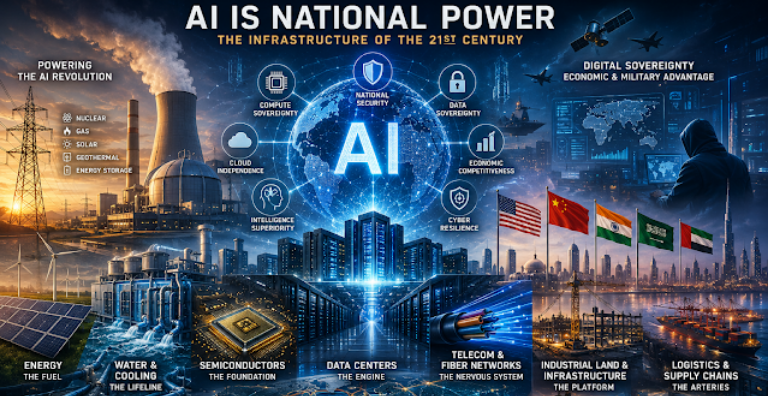
The AI revolution is becoming synonymous to electricity in the 20th century, oil during industrialization and nuclear capability during the Cold War. Countries are no longer seeing AI as ‘just tech’. They are seeing it as an economic infrastructure, military leverage, geopolitical power and critical to national security. Nations globally want to build their own indigenous AI stack and systems to maintain self-sufficiency especially in the current times as deglobalization and supply chain vulnerabilities are becoming visible. Governments fear dependence on foreign AI for critical systems such as military software dependent on foreign cloud providers, national data processed externally and emergency infrastructure controlled by foreign AI systems. That creates strategic vulnerability. A country dependent on foreign AI systems risks surveillance, hidden backdoors, sanctions, cutoff from compute access, manipulation of information and economic dependence. Therefore nations like the United States, China, India, Saudi Arabia, and United Arab Emirates are investing heavily in sovereign AI stacks. Countries want to build their own sovereign clouds, local models, domestic compute, trusted semiconductor supply and national cybersecurity capability. The broader consensus is that future national power may depend not only on GDP or military size but on who controls the intelligence infrastructure underlying economics and society. The objective of AI as national security is resurrecting the old forgotten and neglected hardware infrastructure industries that were once considered old economy sectors such as power generation, utilities, industrial cooling, construction, chip fabrication, logistics, water systems and telecom infrastructure. The AI revolution may become the largest infrastructure buildout since the industrial age. Every AI query devours enormous amounts of energy, AI models need massive data centers to run on, data centers require cooling systems, cooling systems require abundant water and energy sources, chips require advanced manufacturing and everything else depends on stable grid power. This blog will highlight the alarming importance of AI as a national security issue, the industries that are gaining back prominence thanks to this shift and which industries can nations focus on to build their own sovereign AI stacks and the infrastructure around it. Let’s look at the example of China and how they have built a country that is ready to ride the AI wave in a self-sufficient manner. China treated the internet as strategic infrastructure in its early days, it was a well thought out strategy and architecture. While many countries viewed the internet mainly as commerce, entertainment, or consumer technology. China viewed it as an economic infrastructure, information infrastructure and national security infrastructure. This led to a change in policy direction and the goal became to never allow core digital systems to be entirely dependent on foreign control. Examples include Huawei in telecom infrastructure, Alibaba in cloud and e-commerce, Tencent in digital ecosystems, Baidu in search and AI, ByteDance in algorithms and recommendation systems. This created domestic cloud infrastructure, local data storage, indigenous software ecosystems, internal digital supply chains ,national cybersecurity rules and internal digital governance. Globally, the ‘Great Firewall’ was often discussed mainly as censorship. However the ‘Great Firewall’ was all about sovereignty. Strategically, it functioned as a digital sovereignty layer, domestic ecosystem protection, cyber control architecture and internal data localization mechanism. It created space for local firms to scale massively without being overwhelmed by foreign platforms early on. That helped domestic champions accumulate users, data, capital, engineering talent and AI training resources. Strategically, this meant that sensitive national data stayed inside national jurisdiction, domestic firms controlled major data flows and AI systems had access to enormous local datasets. Data became viewed similarly to strategic resources, industrial assets, economic infrastructure. China did not rely only on private venture capital it combined state funding, subsidies, long-term industrial planning, infrastructure financing and protected scaling environments. This allowed investments in semiconductor fabs, AI parks, cloud infrastructure, telecom equipment and smart manufacturing. China has increasingly integrated AI into manufacturing, logistics, surveillance, finance, military systems and industrial planning. The state viewed AI as productivity infrastructure, strategic capability, military multiplier and economic competitiveness tool. This led to national AI strategies, state-supported AI labs and compute infrastructure expansion. China’s rise showed the world that internet infrastructure is national power, AI capability is industrial capability, compute is geopolitical leverage and digital sovereignty increasingly matters. It’s a lesson for nations to treat AI, telecom, cloud, semiconductors, and infrastructure as strategic national assets rather than only private commercial sectors. Many regions are now pursuing their own versions of ‘digital sovereignty’: The common realization is a nation dependent entirely on foreign digital infrastructure may eventually face strategic vulnerability. This is proving true in the current geopolitical dynamics. Besides national security dependence on outsourced digital infrastructure can seriously affect internal security ecosystem like intelligence dominance, data sovereignty, social stability, information integrity with narrative peddling by vested foreign interests. What can other nations do to become AI savvy and become digitally sovereign nations? AI has turned compute into a strategic resource. Previously countries imported software and this dependence was inconvenient but manageable. Now AI systems influence defence, intelligence gathering, finance, cyber operations, biotech, industrial productivity, information ecosystems. Hence making compute sovereignty is strategically important for the future. That’s why leaders are discussing sovereign clouds, national GPU reserves, domestic semiconductor capability, local AI models and protected data infrastructure. AI is becoming the defining infrastructure layer of the 21st century. AI capability now fosters GDP growth, military competitiveness, labour productivity, scientific leadership and financial power. Hence governments are subsidizing AI compute, funding semiconductor plants, building sovereign clouds, partnering with energy firms and creating national AI missions. For example European Union AI sovereignty initiatives, OpenAI partnerships with governments, Microsoft and Google building massive global AI infrastructure, sovereign AI programs in the Gulf and Asia. The AI era is re-industrializing technology. The winners may not only be app companies or consumer internet platforms but increasingly valuable sectors will include electricity, utilities, semiconductors, industrial automation, telecom infrastructure, cooling systems, energy storage, nuclear engineering, construction engineering and optical networking. Therefore investors and governments now see AI as a convergence of software + industrial systems + energy infrastructure. If AI is the cognitive engine of national security, the physical elements such as power, semiconductors, water,
