
The elements of power in the 21st Century Mining Not Drilling will rewrite geopolitics and world order
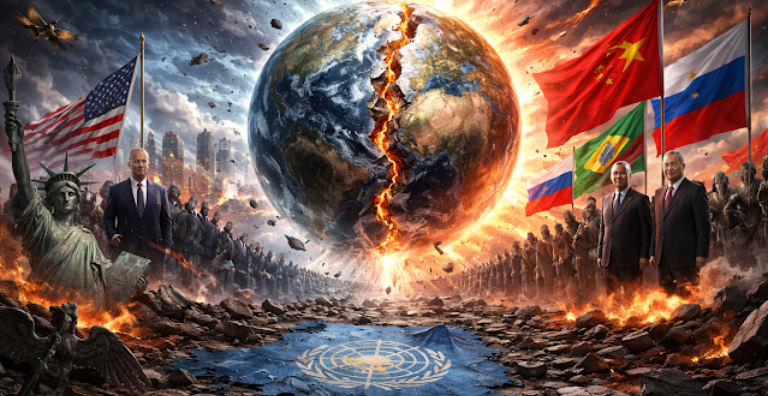
The power dynamics in the world of geopolitics is never cast in stone, it keeps changing based on which region has favorable cards in their hands. As Ray Dalio mentions no empire can last forever, they are bound by cycles. A dominant power in one era can become a weak nation in next era as seen with the rise and fall of empires from the Dutch to the British to the American and probably the rise of the Chinese over the coming decades. In the 20th century nations that could claim geopolitical power were the ones who had control over gold reserves, military strength, industrial manufacturing, oil control and reserve currency dominance. It was a century defined by energy extraction, military force and financial dominance. Tectonic shift in power dynamics led by critical minerals, AI, Currency- the new axis of global power In the 21st century power is shifting to nations that have access to critical minerals, rare earth elements, their supply chain control, semiconductor dominance, energy transition leadership, technological ecosystems and cyber and AI capabilities. The 21st century is all about technology systems, energy transition, mineral control and digital infrastructure. There has been a metamorphic shift in the geopolitical world as world view has shifted from oil fields and tankers to battery plants and chip fabs and from gold vaults to data centers. Oil geopolitics was about energy security; mineral geopolitics will be about technological supremacy. The next hegemon will control materials that power AI, defense systems, space tech and electrified infrastructure. Critical minerals have become a strategic asset and having ownership of them is of utmost importance for national and economic security and energy infrastructure for any nation. Like access to oil was dominated by certain regions (eg: OPEC or OPEC+) access to critical minerals too is geographically concentrated by a handful of regions eg: China, Africa, Latin America and Australia. These new nations will come to center stage in the coming decades as other nations (developed and developing) try to build strategic alliances with these nations to secure access to the critical minerals and their supply chain. In addition nations may try to identify ways to become self-sufficient by building their own critical mineral supply chains (refining, processing etc) or explore their regions for extraction these of critical materials. Let’s see how critical minerals are rewriting world power dominance, geopolitics, business dynamics, defense, currency power and AI supremacy? Critical minerals are the new oil and new crown jewel- lithium, cobalt, nickel, copper, graphite, rare earth elements. Let’s zoom back in time and see what factors characterized strong dominant nations: Before oil became a dominant strategic source national power was displayed by factors such as land and agriculture, precious metals (gold and silver), access and control of trade routes/ naval power, coal as a dominant resource powering industrialization, military power and strength and population size (manpower/ labour). Oil rich nations essentially the OPEC nations rose to power in the 20th century as demand for oil accelerated astronomically. Oil was a major source of power as it fueled automobiles, manufacturing processes in factories, aviation, defense and in turn economic growth. The US created the petrodollars system as a tool to maintain its currency dominance after letting go of the gold standards, to reinforce US financial power, US geopolitical leverage and dollar dominance and hegemony. Countries with large oil reserves or control over oil trade gained enormous leverage. However as the world gravitates towards electrification and AI adoption; a new recipe for geopolitical leverage has come to light: Critical Minerals and Rare Earth Elements. These materials are powering today’s EVs, batteries, AI data centers, renewable energy, semiconductors. Countries that lead in EV manufacturing, AI chips, advanced batteries and nuclear power will shape the next era of power. AI dominance will depend on semiconductors, advanced chips, rare earth magnets, power and data centers. AI supremacy will not be about algorithms but about who will control the materials that build the machines that train the algorithms. So, who has been the early winner in the race of the hare and tortoise? China had strategic foresight to predict the importance of critical minerals and rare earths. They made strategic, calculated and deliberate policies over the last decades to build a dominant position for itself in the minerals supply chain, a vision extended by Deng Xiaoping in the 90s. China is home to a vast reservoir of critical minerals and rare earth and on top of that it has built a complete manufacturing ecosystem around it including mining, extraction, refining, processing and manufacturing. It dominates in rare earth processing, battery supply chains and solar panel manufacturing. In addition China has had the first mover advantage of securing critical minerals via its belt and road initiative around the world in countries like Latin America and Africa. Today China holds the power to influence trade negotiations and impose export restrictions as a single source supplier for majority of these materials. China boasts a leverage similar to what OPEC nations had from the 1970s, it is a single dominate player. Let’s have a look at the nations that have a dominating position in critical minerals and rare earths. China controls around 60% of global rare earth mining and 90% of processing and refining especially for magnets. The democratic republic of Congo produces around 70% of worlds cobalt. Australia and Chile are mining producers of lithium, 50% and 25% respectively while China controls refining and processing of 60% of lithium. Indonesia has 42% of global reserves of nickel. China dominates 3/4th of global graphite output followed by smaller players like Brazil, Mozambique and Madagascar. Chile is the leading exporter of copper, followed by China, Peru and DRC. The Lithium triangle, Chile, Bolivia and Argentina is renowned for 75% of global reserves found. According to IEA, China controls processing and refining of 19 out of 20 strategic minerals. These countries will gain geopolitical leverage in the 21st century. Middle East oil economies are diversifying to remain relevant in
